Jun 08, 2026 · 6 min read
Four dry fire drills that actually carry over to the range
Dry fire is the cheapest skill you have, and the most wasted. Four drills, a printed target on the wall, ten minutes a day. That is the whole program.
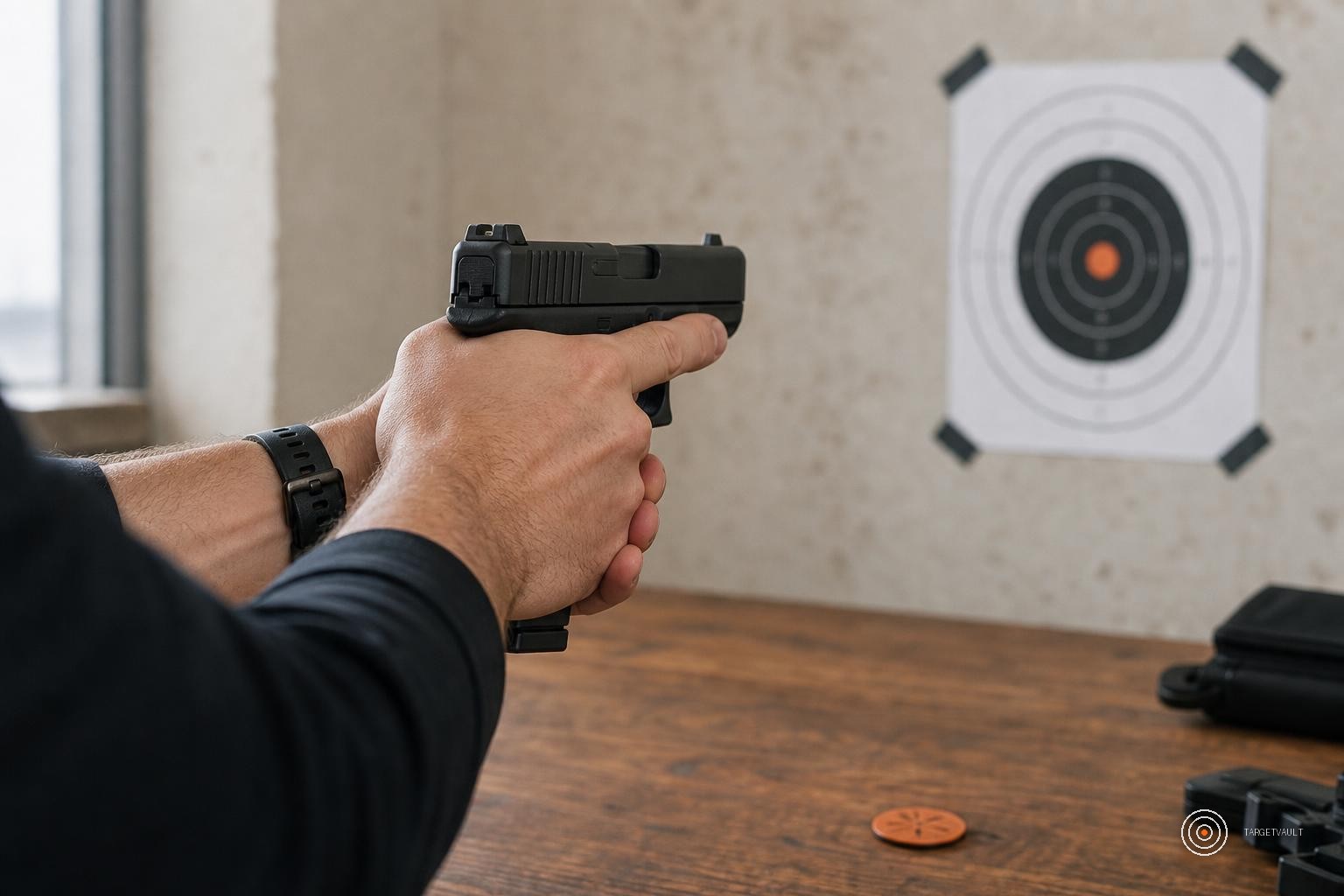
Dry fire is the cheapest skill builder shooters have, and it is also the most wasted. No target, no structure, no timer, you are mostly grooving bad habits. Pin a printed target to a wall, set a shot timer app, and run these four. Ten minutes a day beats one chaotic hour a week.
Safety first, every single time
- Unload the firearm. Visually and physically check the chamber.
- Remove all live ammunition from the room. Different room is better.
- Pick a backstop that would actually stop a round.
- Recheck after any break, phone call or distraction.
Drill one. The wall drill
Stand close enough that the muzzle nearly touches the target. Press the trigger slowly while keeping the sights on a single dot. If the sights dip when the trigger breaks, your press is unbalanced. Five minutes a day. Boring, effective, non negotiable.
Drill two. Par time presentation
Set a shot timer to a 1.5 second par. From a low ready, get a clean sight picture on a small aim point before the beep. Tighten the par to 1.2, then 1.0. Use a dot drill sheet so missed presentations are obvious even without ammo.
Drill three. Reload sequencing
Dummy magazines, racked slide. Beep, fire dry, drop the mag, insert the dummy, rack the slide, get a fresh sight picture. The gap between gun down and gun up is where competition shooters save full seconds. Pattern it in until it is silent and smooth.
Drill four. The cold dot
Once a day, no warm up, no second tries. Present, get a perfect sight picture on a 1 inch dot at 3 meters, press the trigger once. If the sights moved, log it. The point is not to be perfect. The point is to know where you actually are without lying to yourself.
Grab dot sheets, B-8s and silhouettes from the library, or download a full training bundle.
Print it, shoot it.
Free printable targets in A4 or A3, ready for the range.
FAQ
How long should a dry fire session be?
Will dry fire damage my pistol?
Do I need a SIRT or laser pistol?